Guide
What the label in a pair of work trousers has to tell you
Two federal rules decide most of what is printed on the tags in your waistband. Here is what they require, what they leave out, and how to read a tag before the first wash.
There are usually two tags inside a pair of work trousers. One tells you how to clean them and one tells you what they are made of. Both exist because a rule says they must, and both are more specific than they look.
Knowing what the rule demands is useful in a practical way: it tells you which parts of a tag are a commitment and which parts are a courtesy. A commitment is worth trusting. A courtesy is worth checking.
The care label, and why it has to be findable
The care rule starts before the washing instructions, with a requirement about where the label lives.
Manufacturers and importers must attach care labels so that they can be seen or easily found when the product is offered for sale to consumers.Federal Trade Commission, 16 CFR Part 423, Care Labeling of Textile Wearing Apparel, read 12 September 2026
That is why a folded pair in a poly bag carries a hang tag with the care information repeated on it. The rule anticipates exactly the case where the label is sewn in but nobody can see it at the point of sale.
The instructions themselves are tightly specified. The washing line has to name the method and, in most cases, the temperature.
The label must state whether the product should be washed by hand or machine.Federal Trade Commission, 16 CFR Part 423, Care Labeling of Textile Wearing Apparel, read 12 September 2026
So machine wash cold is a complete instruction under the rule, and it is a boundary rather than a suggestion. If a label names cold, warm water is a risk the maker has not accepted.
Bleaching is handled the same way, with the wording fixed by the rule rather than left to the maker.
If regular use of chlorine bleach would harm the product, but regular use of a non-chlorine bleach would not, the label must say “Only non-chlorine bleach, when needed.”Federal Trade Commission, 16 CFR Part 423, Care Labeling of Textile Wearing Apparel, read 12 September 2026
This is the sentence that explains a phrase people read as marketing. Only non-chlorine bleach, when needed is not the maker being careful with words: it is the exact wording the rule requires for a fabric that chlorine would damage and oxygen bleach would not. On dyed work trousers it appears constantly, and it means what it says.
What the care label does not promise
The rule covers regular care for ordinary use. It does not cover getting concrete out of a knee, and it does not promise that following the label keeps a pair looking new.
It also says nothing about shrinkage. A maker may say pre shrunk and most do, but that claim lives outside the care rule and carries no fixed definition of how much movement is allowed. This range is described by its maker as pre shrunk in most cases, and that hedge is the maker's own wording. We keep it rather than round it up.
Nor does the rule require a drying temperature when high heat would not harm the product. An absent temperature therefore means one of two things: the fabric tolerates anything, or the label is incomplete. On a cotton work trouser, treat an absent temperature as permission rather than as a guarantee, and dry on low anyway. Heat is what moves an inseam.
The fibre content tag, and the five percent line
The second tag is governed by a different rule, and the number that shapes it is five percent.
the respective generic names of all fibers present in the amount of 5 per centum or more of the total fiber weight of the textile fiber product shall be used when naming fibers in the required informationFederal Trade Commission, 16 CFR Part 303, Rules Under the Textile Fiber Products Identification Act, read 12 September 2026
Anything at five percent or more of the weight must be named with its generic name: cotton, polyester, spandex. Below that line the rule takes the name away.
no fiber present in the amount of less than 5 percent of the total fiber weight shall be designated by its generic name or fiber trademark in disclosing the constituent fibers in required information, but shall be designated as “other fiber.”Federal Trade Commission, 16 CFR Part 303, Rules Under the Textile Fiber Products Identification Act, read 12 September 2026
That is the origin of the phrase other fiber, which reads like evasion and is in fact compliance. A pair reading ninety seven percent cotton, three percent other fiber is telling you there is a small amount of something the rule will not let it name.
For work trousers the practical reading is short. One hundred percent cotton means heavy, durable, slow to dry. Ninety eight and two with spandex means the same cloth with an inch of give at the waist and across the knee. A large polyester share means faster drying and less abrasion resistance at the same weight, which is a fair trade for some jobs and a bad one for kneeling.
Reading a tag in the shop, in thirty seconds
- Find the fibre line first. It tells you how the pair will behave wet, in heat and against grit.
- Read the wash temperature as a ceiling, not a preference.
- Look for the bleach sentence. The fixed wording tells you whether the dye is chlorine sensitive, which on dark work trousers it usually is.
- Ignore the drying temperature if it is missing, and dry low regardless.
- Check where the label sits. A label at the back of the waistband rubs. One in the side seam does not.
None of that takes long, and it settles most of the questions people ask after the first wash instead of before it.
What the rules leave entirely alone
Two federal rules sound comprehensive until you list what they do not touch.
Neither rule says anything about fit. There is no legal meaning to relaxed, regular or traditional, and no requirement that a thirty eight from one maker matches a thirty eight from another. Those words are the maker's own vocabulary, and comparing them across brands is guesswork.
Neither rule covers durability. Reinforced seams, double stitching, bar tacks and rivets are construction claims, not regulated terms. When this site repeats them it repeats them as the maker's words, because that is exactly what they are.
Neither rule requires a fabric weight, so the ounce figure that denim buyers care about appears on some tags and not others. When it is absent, the only honest thing to say is that it is absent.
And neither rule has anything to do with protective performance. Flame resistance, arc rating, cut resistance and high visibility are separate standards with separate certificates. A care label saying tumble dry low tells you nothing about whether a garment is safe near an arc, and no pair in this range carries any of those ratings.
The third thing on the tag: who made it and where
Alongside the fibre line there are usually two more pieces of information, and both come from the same rule as the fibre content. One is the identity of the company responsible for the garment. The other is the country where it was processed or manufactured.
The company may appear as a name or as a registered identification number, a short code beginning with RN. Both are acceptable, and the number is common on workwear because it fits on a smaller tag. If you ever need to know who stands behind a pair, that code is the thread to pull: it resolves to a single company.
The country line is the one people read most and misread most often. It refers to where the garment was processed or manufactured, which is not the same as where the cotton was grown or where the cloth was woven. A pair can carry cotton from one continent, cloth from another and a sewing line in a third, and the tag names the last of those.
This site does not restate the country line on product pages. The tag in the waistband is the authority, it is the thing that will still be correct in two years, and a repeated line on a web page is a copy that can quietly drift from the garment it describes.
A tag, read line by line
Take a tag that reads: 100% cotton. Machine wash cold with like colors. Only non-chlorine bleach, when needed. Tumble dry medium. Warm iron if needed. Made in Bangladesh. RN 00000.
Line one is regulated and complete: a single fibre above five percent, named generically. This pair will be heavy when wet, will hold its shape against abrasion and will take a long time on the line.
Line two names the method and the temperature, which is everything the washing rule asks for. With like colors is the maker being helpful rather than the rule being satisfied, and on an indigo pair the first two washes really do run.
Line three is fixed wording, quoted above, and it tells you the dye is chlorine sensitive. Line four names a drying temperature, which means high heat would harm the pair. Medium is the ceiling, and low is the sensible habit if you care about the inseam.
Line five is conditional by design. Ironing has to appear only when it is needed regularly or when a warning requires it, so its presence here is a small signal that the fabric creases.
Lines six and seven are the origin and the responsible company. Neither tells you anything about quality, and reading them as a quality signal is the most common mistake people make with a tag.
Where tags go wrong, and what to do about it
Tags are printed in long runs and garments change slowly, so the failures are predictable.
- The tag is missing entirely from a folded pair in a bag. The care information should then be on the outside of the package or a hang tag. If it is on neither, the pair is out of step with the rule.
- The tag is illegible after a year. Photograph it on the day it arrives. It costs nothing and it settles every later argument about temperature.
- The fibre line and the fabric disagree by feel. Trust the line: it is a regulated statement, and hand feel is a poor instrument.
- Two tags in one garment disagree, usually because a lining has its own content line. Read the one attached to the shell for the shell, and treat the lining line as being about the lining.
None of these are reasons to send a pair back on their own. They are reasons to read the tag once, early, while it is still legible.
Why this page quotes instead of paraphrasing
Everything above that is a legal requirement is quoted word for word, with a link to the section and the date we read it. That is deliberate, and there are two reasons for it.
The first is that paraphrase drifts. Must state a water temperature becomes should mention the temperature becomes ideally lists a temperature, and three steps later a requirement has turned into advice. Quoting stops the drift at the source.
The second is that these rules change. The text on this page was read on the date printed beside each source, from the electronic Code of Federal Regulations, which carries the current text rather than a snapshot. If a section is amended, our quote will stop matching, and a check that runs on every build of this site compares each quotation against the saved text character by character. A quote that drifts fails the build rather than sitting quietly on the page.
That check is also why the quotations here are short. A sentence can be verified. A page of restated regulation cannot, and it would be a worse read besides.
From the range
Pairs whose tags we quote from

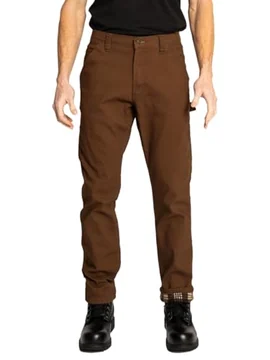
Carpenter Fleece Lined Canvas Stretch Performance Pants, Regular Fit, Utility Pocket & Hammer Loop, Brown, Dark Brown
Waist 38-44 · 30-34" inseam · Regular fit 4.6 out of 5 (22 for this model) $29.99 - $34.99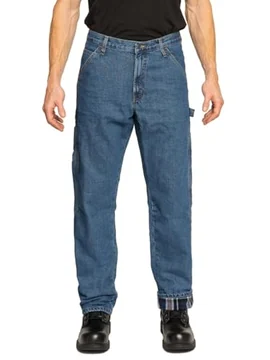
Carpenter Flannel Lined Denim Jeans, Relaxed Fit, Utility Pocket & Hammer Loop, Light Wash, Light Stonewash
Waist 56-60 · 32" inseam · Relaxed fit 4.5 out of 5 (53 for this model) $39.99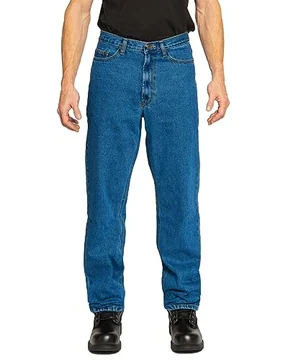
5 Pocket Denim Jeans, Relaxed Fit, Light Wash
Waist 32-60 · 30-36" inseam · Relaxed fit 4.4 out of 5 (437 for this model) $19.99 - $24.99How this site handles the same information
Every product page here lists the maker's own construction and fabric wording and nothing beyond it. Where the maker names a fibre blend, the page says so. Where the maker says nothing, the row is missing rather than filled with a plausible guess.
The same applies to the wash. This site does not print a care instruction for a pair it has not seen a label for, because the label on the garment is the authority and a repeated instruction on a web page is a copy that can drift out of date.
What the pages do carry is the size table, the colour, the cut and the figure, updated on a schedule with the date printed. Those are the things we can state exactly, and the guides are where the rest of the reasoning lives.
Sources
- Federal Trade Commission, 16 CFR Part 423, Care Labeling of Textile Wearing Apparel, read 12 September 2026
- Federal Trade Commission, 16 CFR Part 303, Rules Under the Textile Fiber Products Identification Act, read 12 September 2026